

Stop letting peak demand decide your electricity bill
For many Malaysia C&I users, the challenge is not only how much electricity they consume. It is when they consume it, and how high their demand spikes during operation. Under Malaysia’s Time-of-Use (ToU) structure, weekday peak hours run from 2.00 PM to 10.00 PM, while off-peak hours cover 10.00 PM to 2.00 PM. Weekends are off-peak throughout the day. This is where Battery Energy Storage Systems (BESS) become more than an energy storage system. BESS becomes a cost-control tool.
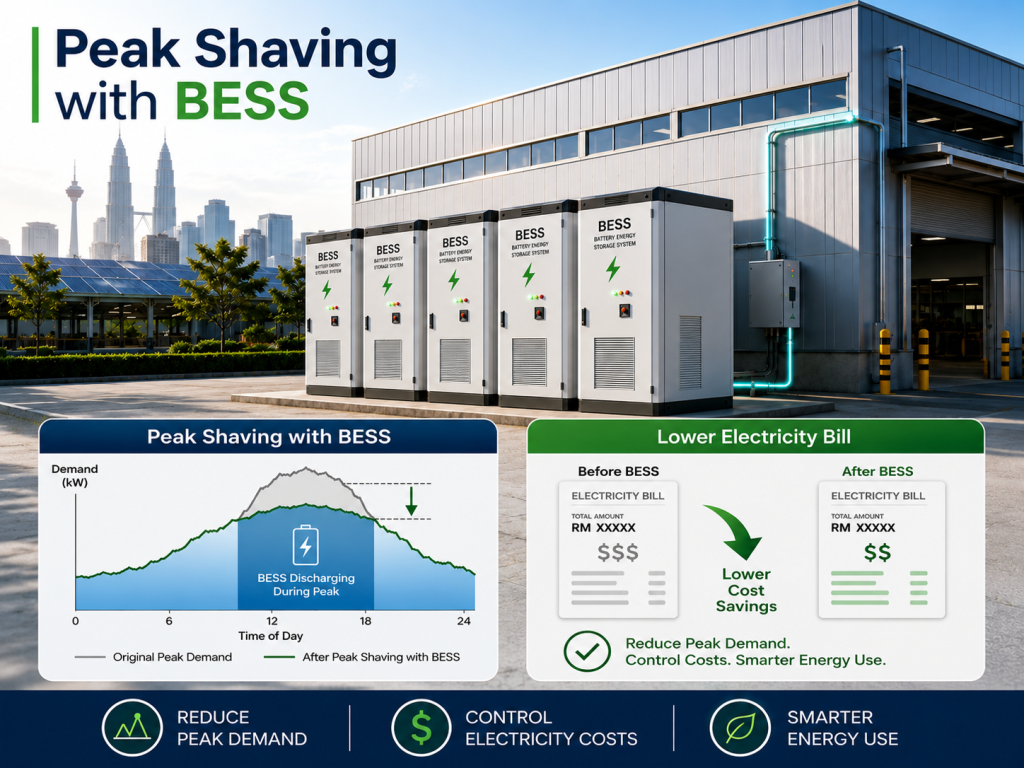
How peak shaving with BESS works
Peak shaving with a Battery Energy Storage System (BESS) is a smart energy management strategy that helps businesses significantly reduce their electricity costs. The system charges from solar PV panels and/or the grid during off-peak hours when electricity rates are lower and demand is minimal. Then, when the facility experiences a sudden demand spike — such as when heavy machinery starts up — the BESS instantly discharges stored energy to support the demand. As a result, the grid sees a much lower maximum demand, preventing expensive peak charges. This approach is especially valuable for factories, warehouses, data centres, commercial buildings, and process industries. Even if these high-demand spikes last only a few minutes, they can drive up demand charges for the entire billing month. By using BESS for peak shaving, businesses can avoid these unnecessary costs and enjoy greater predictability in their energy expenses.
Benefits of Properly Sized and Controlled BESS
With the right sizing and intelligent control strategy, Commercial & Industrial (C&I) users can unlock multiple powerful benefits from a Battery Energy Storage System (BESS). These include reducing maximum demand charges, shifting energy consumption away from expensive peak tariff periods, maximising solar PV self-consumption, and smoothing out sudden demand spikes caused by heavy equipment such as chillers, compressors, cranes, pumps, production lines, or EV chargers. Beyond cost savings, a well-designed BESS also enhances energy resilience, improves operational stability, and supports broader sustainability goals through smarter energy management.
The key is not simply installing a battery — it’s about sizing and controlling it correctly to match your specific operational profile and energy objectives.